
Informative article
What determines the cost price of an injection-moulded part?
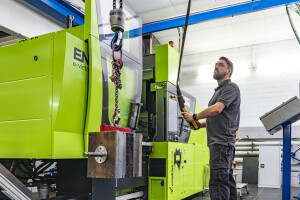
The cost of an injection-moulded part is determined by a number of factors, and anyone who understands these factors can make informed choices that will reduce costs in the long term.
Tooling costs: the upfront investment
The mould is the largest one-off investment in an injection moulding process. Depending on the complexity, number of cavities, mould steel and country of origin, the cost of tooling ranges from a few thousand euros for a simple single-cavity mould to hundreds of thousands of euros for a multi-cavity hot-runner mould made from hardened steel.
The decisions made when purchasing a mould have a significant impact on the cost price of a component: does the mould produce one product per cycle? Or does it produce several per cycle? Furthermore, the length of the cycle – and consequently the machine’s operating time and costs – is also largely determined by the quality of the mould.
If you only need a limited number of products, it may be worth saving on the mould. In that case, your product price may be slightly higher, but the upfront investment will be lower. For large production runs or products that need to be manufactured for many years, it is often wise to invest a little more in the quality of the mould.
Material costs and choice of materials
Raw material prices vary significantly depending on the type of plastic. Standard polyolefins such as PP and PE are relatively inexpensive; engineering plastics such as PEEK, PPS or PA4.6 are considerably more expensive per kilogram. In addition to the base price, material consumption per component plays a role: wall thickness, volume and the amount of runner or sprue material determine how many grams are processed per cycle. Material efficiency in the design has a direct impact on ongoing raw material costs.
Standard plastics (PP, ABS, PE): lowest raw material costs
Engineering plastics (PA, PC, POM): mid-range
Engineering grades (PPS, PEEK, PA4.6): highest raw material costs
Colourants, fillers and additives add to the cost of the base compound
Machine hourly rate, cycle time and utilisation
The machine costs per part are determined by the hourly rate of the injection moulding machine, the cycle time and the number of parts per cycle. A machine with a higher clamping force has a higher hourly rate, but is sometimes necessary for large or thin-walled products.
The cycle time is the time taken from injection to ejection and is directly related to wall thickness and cooling efficiency. A multi-cavity mould increases output per cycle, thereby reducing the unit cost of production, albeit at the expense of a higher initial investment in tooling.
Additional costs: post-production, quality control and logistics
In addition to direct production costs, indirect costs also play a role: quality control, packaging, storage and transport. Components that require further processing, such as printing, welding or assembly, incur additional costs that must be factored into the total cost of ownership.
A fully outsourced solution, in which the injection moulder also handles assembly and packaging, can deliver economies of scale and reduce coordination costs for the client. De Beer Plastics offers a wide range of additional production steps within its own facilities. This gives you control over costs and an efficient production partner.

Moulding challenges into Reality
