
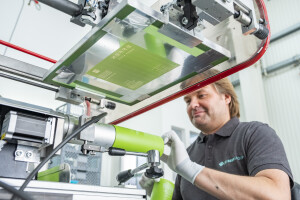
Printing on plastic
Printing on plastic
Printing on injection-moulded products is a combination of the right materials, processes and machinery.
The finishing touch for your plastic product
If a plastic product is to be printed on or marked, this is a critical step in the production process. The right combination of materials and techniques often plays a decisive role in the early stages of a project.
De Beer Plastics has experience in printing and marking a wide range of plastics, from soft materials to engineering plastics. We use a variety of techniques, including pad printing, screen printing, inkjet printing and laser marking.
Choice of materials
Not all plastics are automatically suitable for printing. In particular, polar plastics such as PE and PP can only be printed on to a limited extent without pre-treatment. If additional pre-treatment steps such as flame treatment or plasma treatment are required before printing, this represents a costly process that can be avoided by choosing different materials.
Selecting the right material and process is therefore a crucial step in the design-for-manufacturing phase, which requires a great deal of expertise in materials. De Beer Plastics has this expertise in-house and will guide you through this process.
Pad printing
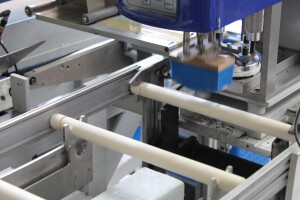
A common method of printing on plastic products is pad printing. This technique is flexible and involves relatively low set-up costs. Using a simple printing plate and a rubber stamp, parts can be printed in both small and large batches.
De Beer Plastics has several pad printing machines, which we use to apply beautiful prints to your products. For large production runs, this process can be fully automated in-line.
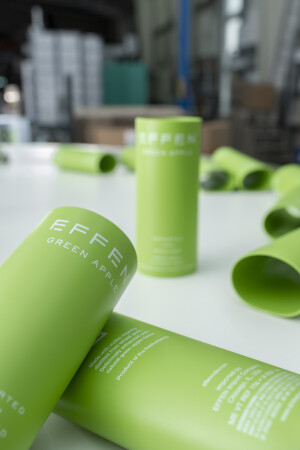
Screen printing
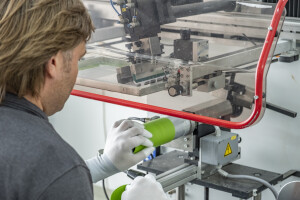
In screen printing, printing inks are applied to a product using a very fine screen through which the print image has been cut out. This technique allows for the production of extremely precise prints, such as small text, with razor-sharp clarity.
De Beer Plastics can print on both flat and cylindrical products using screen printing. To this end, we have set up a special low-dust area at our factory in Linsengericht to ensure a perfect result.

Moulding challenges into Reality
