
Mould making
Mould making
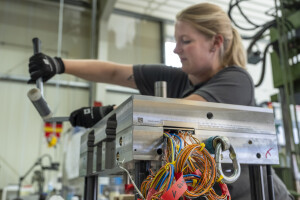
The quality of the mould determines the quality of the product. That is why De Beer Plastics prefers to keep this in-house.
Moulds: the basis of injection moulding
The production of high-quality injection-moulded products begins with the development of an injection mould. This involves a combination of many technical innovations, which together ensure that a product can be created.
How can you develop ingenious demoulding methods? What is the best way to inject-mould the product? How do you ensure optimal cooling of the mould? How do you ensure that all dimensions remain within the specified tolerances? These are all areas where the designers and engineers at De Beer Plastics draw on their many years of experience to achieve a perfect result.
Made by De Beer
Manufacturing moulds in high-wage countries such as the Netherlands and Germany presents a challenging business case. And purchasing moulds is often a perfectly good solution. Nevertheless, De Beer Plastics remains committed to its strategic capability of in-house mould manufacturing.
We believe that without this in-depth and ongoing expertise in mould-making, no company is capable of developing products that are truly innovative. We devise, we experiment, and through trial and error we create moulds that continually push the boundaries of what we can achieve. And you simply can’t do that if you have everything manufactured on the other side of the world.
Combination moulds
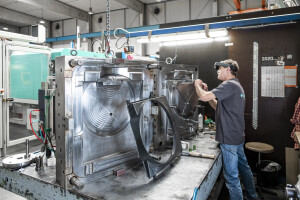
Making smart use of scarce resources to ensure projects are cost-effective. That is the main reason for combining multiple products in a single mould. Expensive components such as a hot runner system and the mould base can be reused in a combination mould.
De Beer Plastics has already built dozens of multi-cavity moulds, some containing as many as 30 different product variants. It can sometimes be quite challenging to coordinate the injection and ejection systems for all these different products, but ingenious solutions can yield significant benefits.
3D-printed moulds
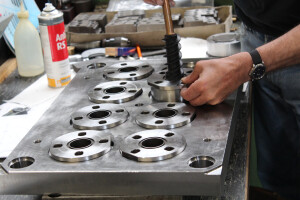
3D printing offers great design freedom and straightforward manufacturing processes. That is why De Beer Plastics uses 3D techniques in mould making: on the one hand, for printing inserts from a stable plastic, enabling us to injection mould small batches of products ranging from a few dozen to sometimes hundreds of units. This allows you to produce real products quickly and cost-effectively from materials selected for mass production.
On the other hand, De Beer Plastics uses 3D printing to build complex cores from metal. This technique has two major advantages: in 3D, you can create cooling channels that are not possible with conventional drilling. And 3D-printed cores are stronger than machined cores, because 3D-printed parts are effectively made up of an infinite number of tiny weld seams. And weld seams are, by nature, stronger than steel.
Special surfaces
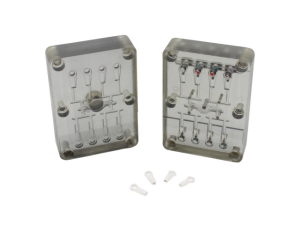
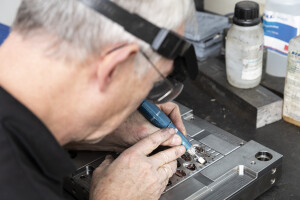
For visible and design components, the surface finish of the mould is crucial to the final result. Achieving a perfect surface requires both craftsmanship and modern technology. De Beer Plastics manufactures numerous moulds for optical components, in which the lenses are polished by hand, one by one – ensuring the highest precision thanks to specialists with many years of experience.
Another type of specialised surface finish involves applying textures to components such as interior parts in the automotive industry. Whether it’s a leather-effect finish, geometric patterns or a very fine matt texture, the challenge lies in achieving consistency – even, or perhaps especially, when repairing or modifying moulds.

Moulding challenges into Reality
