
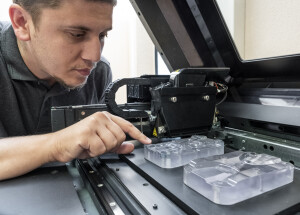
Research & Development
Research & Development
The interplay between product design, materials, mould design and process design. That is where the magic happens.
Without R&D, there can be no innovative products
‘Moulding Challenges into Reality’ is not just an empty slogan, but a promise to innovative customers who want to explore and push the boundaries of what is possible. De Beer Plastics is a partner in this endeavour.
Research and development is the driving force behind this progress. Coming up with ideas, building prototypes and then validating them – all under one roof. That is the strength of De Beer Plastics as a partner in co-creation and production.
All the expertise, one supplier
Moulds can be manufactured anywhere in the world. However, production partners with in-depth knowledge of both mould making and plastic injection moulding are becoming increasingly rare. De Beer Plastics believes in the power of this combination and therefore ensures that this core competence is carefully maintained.
It helps us devise technical solutions that go beyond the standard. But it also helps to shorten development cycles, both during the engineering phase and when testing and optimising moulds during initial trials. Quick adjustments and repairs can be extremely valuable on projects with tight deadlines.
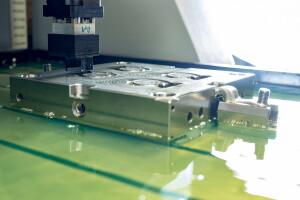
Engineering
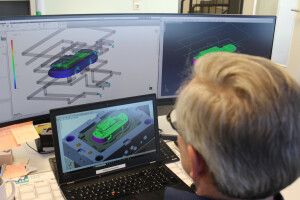
We usually come into the picture once the customer already has a rough idea of what a product should look like. That’s when our challenge begins: turning your idea into reality. De Beer Plastics has engineers with in-depth knowledge of how to adapt products for mass-production plastic injection moulding. They get to work on your product, first to ensure it is manufacturable, and then to optimise it: for final quality, production efficiency or for assembly, where an entire assembly comprising multiple components is coordinated.
Based on this optimised product design, the mould structures are designed. Whether it’s innovative ejection systems, optimal cooling systems or advanced injection systems: every element requires experience and knowledge of the latest state of the art.
As a customer of De Beer Plastics, you’ll always have direct contact with our top engineers. It’s only through close, direct collaboration between customer and engineer that truly exceptional results are achieved.
Mould management
We manufacture our own moulds in-house at each of our four sites. However, this only covers a portion of our projects. Primarily strategic projects where we keep the knowledge and expertise within our own organisation. Or projects where our client wants us to keep the knowledge within our company, for example to protect intellectual property.
In addition to our in-house mould-making facilities, we have worked closely with various partners in Europe and Asia for many years. Thanks to our extensive network of partners, we have access to the necessary expertise and capacity, enabling us to complete projects involving as many as several dozen moulds within very short timeframes. Project managers from De Beer Plastics act as coordinators between external and internal partners.
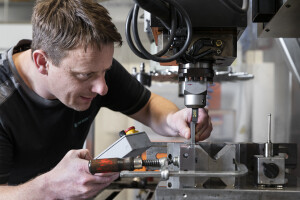
Process design & automation
Without a suitable production process and efficient automation, a project is not complete. De Beer Plastics manufactures in countries where we cannot afford to produce inefficiently. It all starts with the right machine settings. That sounds logical, but the difference between a highly skilled machine operator and an average one is enormous, and has a direct impact on cycle times, product quality and output.
When developing products, we take into account from the outset the machine on which the product will be processed, as well as the automation systems on and around the machine. Each machine is equipped with advanced linear robots, which are supplemented by specialised gripper systems tailored to the specific products. These robots can be used flexibly for picking up and placing products, which forms the basis for many production processes.
For every project, we explore what else is possible: automated packaging, assembly, printing or quality control. Downstream assembly systems are also developed in parallel with moulds, either in-house or in collaboration with specialist partners.
APQP and PPAP
Advanced Product Quality Planning (APQP) is our structured approach to developing new products or implementing major changes. This enables us to identify risks at an early stage, exceed customer expectations and minimise issues during mass production.
APQP is the standard under IATF 16949 for the automotive industry, but it can be applied to any development process. The APQP process consists of five phases: definition of customer requirements and planning, product and process design, validation, and a feedback loop.
Products are approved via the PPAP (Production Part Approval Process), through which we demonstrate our ability to manufacture production parts that consistently meet all specified requirements and tolerances.

Moulding challenges into Reality
