
Injection moulding
Vertical injection moulding
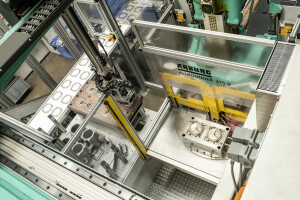
Injection moulding, but at a 90-degree angle. Vertical injection moulding requires a change in approach, but makes it possible to overmould inserts.
Automation
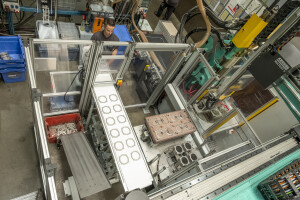
Vertical injection moulding machines are equipped with a turntable that allows a new insert to be loaded whilst the machine is still in operation. This loading of a new insert can be done manually, but for large production runs we have robots that can do this automatically.
Automation is tailor-made and developed for specific projects. For example, we have a setup in which an aluminium casting is sequentially overmoulded on two vertical machines, with a special pre-treatment step in between for the second stage.
If you also have a challenging project involving the overmoulding of metal components with plastic, De Beer Plastics is an experienced partner for you.
Moulds for vertical injection moulding
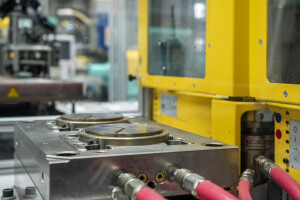
Although the technique of vertical injection moulding does not differ greatly from horizontal injection moulding in principle, the moulds used for vertical injection moulding are often slightly more complex. This is because account must be taken of the rotation of the machine’s base and of the filling and unloading carried out by a robot.
In its in-house mould-making facility, De Beer Plastics also develops and manufactures vertical moulds designed for the production of hybrid components using insert moulding.

Are you looking for a reliable and competent partner to manufacture your products?
In-house mould making and R&D for co-creation
Ample capacity across more than 100 machines in three factories
A proven track record in challenging projects

Moulding challenges into Reality
