
Informative article
How does an injection mould actually work?
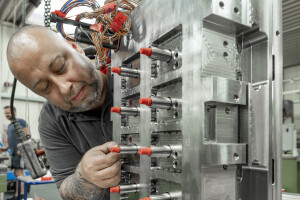
The mould is at the heart of the injection moulding process. The quality, service life and cost of every component depend directly on how well the mould has been designed and constructed.
The anatomy of an injection mould
An injection mould consists of two main halves: the fixed half (on the injection side) and the movable half (on the ejection side). Together, they form the cavity in which the plastic component takes shape. Within this basic structure, a mould contains an injection system for feeding molten material, a cooling system for rapid and uniform cooling, and an ejection system to push the component out of the mould after solidification. The precision with which all these systems are coordinated determines the quality of the end product.
Hot runner vs. cold runner: a fundamental choice
In a cold runner mould, the material solidifies in the feed channels and is ejected as a runner together with the part. In a hot runner system, the material in the feed channels remains liquid thanks to heating elements, meaning no runners are formed. Hot runners are more expensive to purchase and maintain, but they reduce material waste and improve cycle times. For parts made from engineering plastics or in multi-cavity moulds, a hot runner system is often the better economic choice in the long term.
Cold runner: lower tooling costs, more material waste
Hot runner: higher initial investment costs, lower unit costs for higher volumes
Whether you use a cold runner or a hot runner also determines where you can inject-mould a product
Hybrid systems combine the advantages of both approaches
Cooling: the key to fast cycle times
The cooling system has a greater impact on cycle time than many engineers realise. Roughly 60 to 70 per cent of the cycle time is determined by the cooling of the part within the mould. A well-designed cooling channel network ensures rapid and uniform cooling, which minimises shrinkage and warping.
By 3D printing cooling channels, it is possible to cool the mould very close to the product’s contour. 3D printing is a particularly effective solution for small, protruding cores, where it is impossible or very difficult to drill holes for conventional cooling. Whilst this does make the mould significantly more expensive to purchase, it can considerably reduce cycle times.
Steel grade, precision and maintenance
The choice of die steel is determined by the material to be processed, the desired surface finish and the intended service life. Pre-hardened steel such as P20 is commonly used for medium-sized production runs; hardened steel such as H13 or S136 is required for glass-fibre-reinforced or abrasive materials.
Regular preventive maintenance, such as cleaning, inspecting ejectors, checking cooling channels and regrinding parting lines, is essential to achieving the intended service life of between hundreds of thousands and several million cycles. At De Beer Plastics, each production site has its own mould-making facility, where maintenance and repairs can be carried out quickly and professionally.

Moulding challenges into Reality
