
Blog
Design for Manufacturing (DFM): designing products that can actually be manufactured
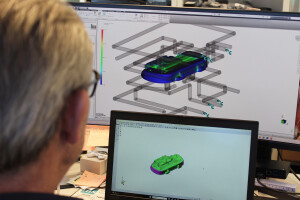
A product that looks perfect on paper but causes endless problems in production is not a good product. DFM bridges the gap between design and manufacturability.
What is DFM and why is it so valuable?
Design for Manufacturing is a structured design approach in which manufacturing considerations are explicitly incorporated into the design process. The aim is to design products that are not only functionally sound, but can also be manufactured efficiently, reliably and cost-effectively.
In the context of injection moulding, DFM means that the design takes into account material flow, shrinkage, ejection, venting and mould complexity. And this should be done at a stage when the design can still be easily modified. Ideally, the DFM review should not be a one-off checklist but an ongoing dialogue between the designer and the manufacturer throughout the entire development process.
The most common DFM issues in injection moulding
In practice, the same design issues keep cropping up during the DFM review of injection-moulded parts. Inconsistent wall thicknesses lead to shrinkage and sink marks. Internal walls that are too steep and lack a draft angle hinder ejection and cause scratches on the part. Undercuts that serve no functional purpose unnecessarily increase mould complexity. Sharp internal corners lead to stress concentrations in the product and are difficult to polish in the mould. Each of these issues can easily be avoided during the design phase if the manufacturing perspective is taken into account at an early stage.
DFM and cost price: the most direct ROI
The return on investment from a proper DFM approach is exceptionally high. Every mould modification that is avoided saves costs; every process simplification reduces cycle time; every assembly step that is eliminated lowers the unit cost.
Research in the product development literature consistently shows that more than 70 per cent of a product’s total life-cycle costs are determined during the design phase. DFM is the systematic approach to influencing those costs at source, rather than attempting to control them later on.
Reduced tooling costs by avoiding unnecessary complexity
Shorter cycle times thanks to optimised wall thicknesses and cooling
Fewer mould adjustments and iteration cycles after T1
Lower assembly costs through product integration
Higher 'First Time Right' quality in mass production
DFM as a shared responsibility
DFM works best when it is not structured as an audit by the manufacturer of the customer’s design, but as a process of shared responsibility. The designer contributes knowledge of function, requirements and context of use; the manufacturer contributes knowledge of process capabilities, moulding techniques and material performance. These areas of expertise are complementary and, when combined, lead to better outcomes than either party could achieve on its own.
A culture of early and open collaboration – even if that means a design needs to be fundamentally revised – provides the most fertile ground for a successful DFM process. And the great thing is: with the right, experienced engineers, a thorough DFM review often takes just a few hours. This is nothing compared to the costs it helps to save.

Moulding challenges into Reality
